
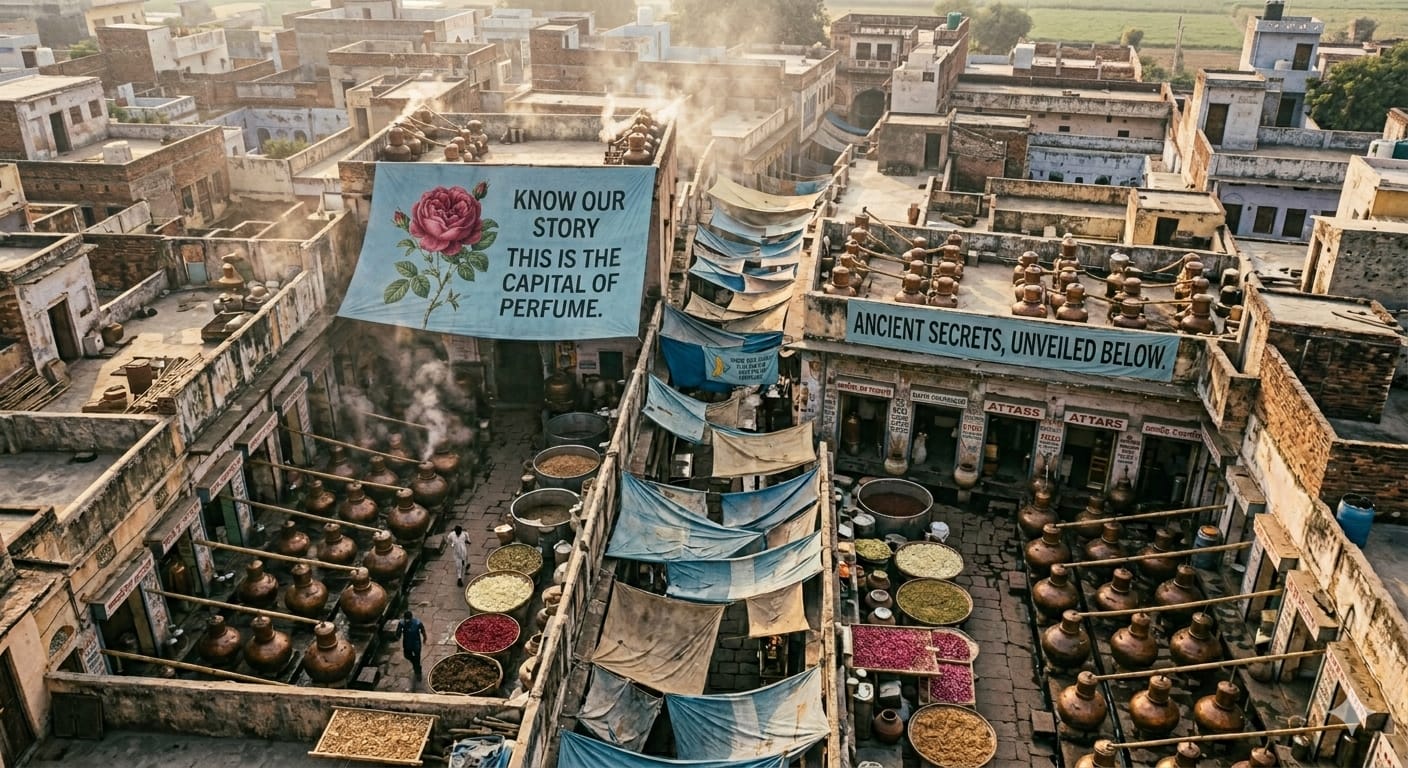
Kannauj, India’s historic perfume capital, needs your attention because it is sitting on a 5,500-year-old artisanal craft that is currently vulnerable. While its traditional, alcohol-free attar is celebrated globally, the industry struggles against synthetic mass-market trends and economic loss.
The ancient scent-making town demands your attention right now for a few critical reasons:
- The Threat of Erasure vs. Global Exploitation
- The Original Craft: For centuries, Kannauj has used wood-fired hydro-distillation to bottle natural, alcohol-free attars from ingredients like the Rosa damascena and petrichor (the smell of baked earth).
- The Economic Drain: French luxury houses and brands from hubs like Dubai routinely buy these artisanal oils in bulk, repackage them, and sell them back at exponential markups.
- The Decline: Despite its historical significance, the number of traditional distilleries continues to drop as younger generations abandon the craft for lack of modern branding and direct-to-consumer strategies.
- A Massive Market Shift Toward Niche Authenticity
- Explosive Growth: The Indian fragrance market is booming and scaling up to an estimated ₹12,000 crore.
- Gen Z Demand: Consumers are moving away from celebrity-backed, synthetic scents and actively seeking natural, sustainable, and story-driven niche products.
- Untapped Potential: Kannauj possesses the exact authenticity and natural ingredients that today’s luxury market craves, waiting for founders to transform them into high-value, modern brands.
- A Step Toward Category Elevation
- Cultural Artifact: Fourth-generation perfumers from Kannauj are beginning to present their original compositions on global art stages (like the Louvre in Paris), shifting the city’s narrative from just a “raw material supplier” to a “creative originator”.